joi, 10 martie 2011

Mitologie japoneza: AMATERASU OMIKAMI

The tale of Ama-no-Iwato, the Heavenly Rock Cave


copyright2001 (c)Jingu-Chokokan

After heaven and earth had been separated, two married kami, Izanagi-no-kami and Izanami-no-kami, gave birth to the land of Japan and to various kami of the seas, the rivers, the mountains and the fields. Finally the two gave birth to three specially revered kami: Amaterasu Omikami, Tsukiyomi-no-kami and Susanoo-no-kami. They gave necklace of jewel beads to Amaterasu Omikami and ordered her to govern Takama-no-Hara (the Plain of Heaven), they further ordered Tsukiyomi-no-kami to govern the night and Susanoo-no-kami to govern the sea. Susanoo-no-kami, however, went against the will of the married deities and gave up governing the sea. Instead he ascended to Takama-no-Hara, and committed outrageous deeds such as destroying the paddy fields and the weaving house on the Heavenly Plain. Amaterasu Omikami angered by his behavior and hid herself in the Heavenly Rock Cave called Ama-no-Iwato. As a result, the world of both heaven and earth became dark, throwing everything into confusion. The eight million kami got together beside the river in the Plain of Heaven, debating how to induce Amaterasu Omikami to come out of the Heavenly Rock Cave. They decided first to make the divine mirror Yata-no-Kagami and hang it in front of the cave, second, to hold a joyous festival, and third, to perform the sacred dance and music called kagura. As a result of this, Amaterasu Omikami emerged from the Heavenly Rock Cave, illuminating everything with her gentle light. She made heaven and earth bright again and brought back harmony and order. Susanoo-no-kami was expelled from the Heavenly Plain to the land of Izumo. There Susanoo-no-kami, killed a giant snake, the Yamata-no-Orochi, which had been tormenting the people of Izumo. He extracted a divine sword out of the snake's tail and presented it to Amaterasu Omikami. This sword is one of the three imperial regalia.


copyright 2001 Jingu Administration Office
(c)Jingu-Chokokan

copyright 2001 Jingu Administration Office
(c)Jingu-Chokokan
The tale of the descent to earth of the descendants of Amaterasu Omikami, and of the 1st Emperor Jinmu

Okuninushi-no-kami, a descendant of the deity Susanoo-no-kami living in Izumo, unified almost all the areas of the world and established the land called Ashihara-no-Nakatsukuni, i.e., ancient Japan. Amaterasu Omikami, the ruler of the Heavenly Plain, decided to send her offspring to govern the land and renew it. She dispatched her envoys several times to Okuninushi-no-kami, in order to negotiate the transfer of sovereignty over the land. Finally, he conceded sovereignty to Amaterasu Omikami. She summoned Ninigi-no-mikoto, her grandchild, and handed over to him the three imperial regalia that certify legitimacy to succeed the throne. she also gave him divine rice in heaven and ordered him to reign over the land of Ashihara-no-Nakatsukuni, guaranteeing everlasting prosperity for his dynasty and his throne. She made Ninigi-no-mikoto descend with other kami and their descendants, to the top of the mountain Takachiho-no-Mine in present Kyushu. There Ninigi-no-mikoto erected a palace and established the basis for the Japanese nation.
The third descendant of Ninigi-no-mikoto left Kyushu, and having overcome many difficulties with protection by Amaterasu Omikami arrived at Yamato, a region located almost at the center of the Japanese islands, in present Nara area. He established the capital at Kashihara and declared that he had founded the Japanese nation. In this way he became the first Emperor, taking the name Jinmu.


copyright 2001 Jingu Administration Office
(c)Jingu-Chokokan

copyright 2001 Jingu Administration Office
(c)Jingu-Chokokan

The tale of the sacred mirror Yata-no-Kagami

The three sacred imperial treasures consist of the sacred mirror called Yata-no-Kagami, the sacred sword called Ame-no-murakumo-no-Tsurugi and the sacred jewel called Yasakani-no-Magatama. According to Shinto thought, the mirror as reflecting everything properly is a symbol for "Honesty," the sword for "Braveness," and the jewel for "Affection."
Now, the sacred mirror is enshrined as the august symbol of Amaterasu Omikami at Ise Jingu, while the sacred sword is enshrined as the august symbol for kami at Atsuta Jingu of Nagoya City, and the sacred jewel Yasakani-no-Magatama is preserved in the Imperial Palace.
When Amaterasu Omikami gave the sacred mirror to Ninigi-no-mikoto, her grandson, she said: "Think of this sacred mirror as none other than myself, take care of it, and worship it forever." Ever since, the successive emperors have worshiped Amaterasu Omikami, believing her to reside in this mirror, and after Ise Jingu had been established, they have worshiped Amaterasu Omikami with even more reverence.

copyright 2001 Jingu Administration Office
(c)Jingu-Chokokan

copyright 2001 Jingu Administration Office
(c)Jingu-Chokokan

The kami (deity or deities)

The kami (deity or deities)


The origin of Iwato-Kagura
Mythology is important to the Japanese people as Greek mythology was important in the beginning of Western culture. However, there is a big difference between the two. In Greek mythology, the king Agamemnon was a grandchild of the god Zeus, but his descendants do not reign anymore as the kings of Greece. In the case of Japan, however, the descendants of kami as described in Japanese mythology are the ancestors of many ancient clans including the Imperial Family.
The concept Japanese have about their deities is quite different from the one Christians, Muslims and Jews have of their God. Amaterasu Omikami is thought to be central among the deities of Japan, but never thought to have the power of an absolute or omnipotent God. This might be due to the influence of the natural environment, and the character of the Japanese as cultivators of rice. Amaterasu Omikami is considered to be a gentle harmonizing presence and symbol of the myriads of kami. She blesses everybody indiscriminately with serene light.
It can be said that Japan is one of the few countries in the world where modernization and great economic growth have been achieved while the traditional deities, with Amaterasu Omikami as spiritual center remain important in people's lives.
copyright2001 (c)Meiji-jingu(Enlarged photo)

Japanese mythology

The Japanese mythology is contained in the chapters covering the age of the kami in both Kojiki (The Record of Ancient Matters) compiled in 712 and Nihonshoki (The Chronicles of Japan) compiled in 720. These stories vividly describe the beginning of heaven and earth, the birth of the land of Japan, the birth of various deities, the genealogical relations between the deities and people. Among the deities mentioned, Amaterasu Omikami, the deity enshrined at Ise Jingu is the most prominent.
However, Amaterasu Omikami does not have the character of the absolute God of Christianity. She is described as a symbol for the myriads of kami, and as the one who brought great harmony to heaven and earth.
Kojiki
copyright 2001 Jingu Administration Office
Nihonshoki
copyright 2001 Jingu Administration Office

The relation between nature and Shinto religion

Japan is situated in the Far East. Geographically, the relation between Japan and Asia is comparable to the one between Great Britain and Europe. Japan is composed of four major islands: Honshu, Shikoku, Kyushu and Hokkaido. 70 % of the land is covered with green forests, and nourished by abundant waters. Japan is endowed with various forms of mountains, seas, rivers and fields. Moreover, the climate is rather moderate with four distinct seasons: spring, summer, autumn and winter.


copyright2001(c)Munakata-taisha
(Enlarged photo)

copyright2001(c)Munakata-taisha
(Enlarged photo)

copyright2001(c)Jinja-honcho
(Enlarged photo)
These characteristics of its geography and climate had great influence on what the Japanese people thought of kami (deities) and nature. Since ancient times, far prior to the establishment of a state government, our ancestors had acknowledged the existence of spiritual beings, or kami, dwelling in all things of nature, such as mountains, forests, seas, rivers, animals and plants, bestowing great blessings upon the people.


copyright2001(c)Jinja-honcho
(Enlarged photo)

copyright2001(c)Jinja-honcho
(Enlarged photo

copyright2001(c)Jinja-honcho
(Enlarged photo)
Our ancestors lived with awe and respect towards the kami.Shinto, the indigenous religion of Japan, is based on these concepts of kami. The ancient Japanese believed in numerous kami, their multitude is expressed by the number eight million.

copyright2001
(c)Fujisanhongu-sengentaisha
(Enlarged photo)
copyright2001(c)Jinja-honcho
(Enlarged photo)
copyright2001(c)Jinja-honcho
(Enlarged photo)
copyright2001(c)Imperial Household Agency
(Enlarged photo)
copyright2001(c)Imperial Household Agency
(Enlarged photo)
Picture of transplanting the rice by Emperor at the Imperial Palace @Picture of harvesting the rice by Emperor at the Imperial Palace

The main industry of Japan since ancient times until the last century was to produce rice. In a rice cultivating community, it is necessary for its members to live in harmony with each other and with the natural environment. They know that prosperity for all could be achieved only if each one contributes his part to the community, and helps others in what they are lacking. Eventually, structures enshrining kami were built for villages and regions, where people gathered to discuss together matters of their community. In this way, people were aware that kami, nature and human beings existed together. For them it was important to live in harmony with each other.
The basis of Shinto faith is the consciousness that nature and human beings are united firmly through the kami. This consciousness is expressed in the ritual forms of worshiping the kami.
Among the many Shinto sanctuaries in Japan, Ise Jingu is the supreme. For the establishment of the state, the key unifying factors were the Imperial Household, for society, and the production of rice for its livelihood. Ise Jingu links the two factors and offers spiritual support for the Japanese in times of confusion. The kami of Ise Jingu is Amaterasu Omikmai, the supreme deity, who is not only the ancestor of the Imperial Family, but also the kami that gave rice to the people, as described in Japanese mythology.

marți, 8 martie 2011

Mitologia japoneza

In studiul mitologiei japoneze este greu sa se traseze o linie intre mit, legenda sau credinta populara, intre religie si superstitie. De fapt, mitologia japoneza este o suma a acestora, un sistem de credinte si traditii ce isi au originea in sintoism, budism sau folclor, si care sunt un produs al acestui spatiu sau au fost importate din alte zone ale Asiei.


In lucrarile de specialitate, antropologii descriu ca mituri, personaje mitologice sau zei, entitati pe care japonezii le venereaza religios. Acestea fac parte din religia Shinto, Budism sau alte credinte si traditii folclorice. In Japonia, coexista, sau mai degraba, se impletesc un numar mare de religii, iar japonezii folosesc practici din mai multe dintre acestea in viata lor de zi cu zi. Astfel, ceea ce majoritatea numim mitologie, pentru japonezi reprezinta practici si credinte religioase, ce fac parte din celebrul spirit japonez.


De asemenea, putem spune ca nu exista o singura mitologie japoneza, ci mitologii japoneze, multiple sisteme de mituri, credinte si traditii ce apartin unui sat, unui oras sau unei prefecturi. La acestea se adauga influente ce vin din alte parti ale Asiei, din China si India sau chiar din Vest. In limba japoneza, este cunoscuta expresia ya-o-yorozu no kami, ceea ce inseamna opt milioane de zei. Acest numar este folosit pentru a desemna infinitul si vine din credinta Shinto ca in fiecare lucru din natura exista o reprezentare a divinitatii, un kami.
Acest numar care tinde spre infinit de zei sau entitati spirituale se afla in centrul credintei Shinto, dar din panteonul japonez mai fac parte si divinitati venerate in templele budiste sau de alte religii. Prin termenul de kami sunt desemnate zeitatile din panteonul shintoist, cele opt milioane, dar si instante ale lui Budha, Dumnezeul crestin si personajele venerate ca sfinti, zeitati hinduse, Allah si orice divinitate care este venerata de o religie sau alta.


Pe langa reprezentari divine, miturile japoneze ofera un numar mare de eroi mitici si personaje istorice, care devin kami, si de fiinte supranaturale, ce formeaza un bogat bestiar.


O alta dificultate a realizarii unui inventar al entitatilor mitologice japoneze provine din numarul mare de nume sub care acestea sunt cunoscute. In functie de surse sau de regiunea geografica in care sunt venerate acestea au nume diferite.


Cosmogonia


       Miturile cosmogonice japoneze sunt concentrate in jurul ideilor de origine divina si unicitate a poporului japonez si a tinutului locuit de acesta. In centrul lumii, si primul tinut creat, sunt insulele japoneze, iar japonezii si imparatul descind din zeii ce au creat lumea pamanteana.

        In traditia Sinto, timpul mitic este impartit in patru ere. Prima era este cea a zeilor (kami) ceresti si a celor pamanteni. Acum au loc creatia cerului si a pamantului, a zeilor si a oamenilor. Cea de-a doua era este cea a imparatilor, de la cei mitici, pana la cei ce pot fi atestati istoric. A treia era este cea a eroilor, in care razboinici si eroi puternici duc lupte pentru imparat, clan sau semenii lor. A patra era, a miturilor locale, a povestilor cu fantome si credintelor ce merg pana in timpurile moderne.

        Sursele miturilor sunt alcatuite din lucrari precum Kojiki, Nihongi (Nihon shoki), Kogo shoi, Fudoki, si Manyosho, ce uneori ofera variante diferite ale aceluiasi mit. Cele mai importante sunt primele doua, Kojiki (Insemnari ale lucrurilor vechi), alcatuita aproximativ in 712 si Nihonshoki sau Nihongi (Cronicile Japoniei), alcatuita in 720. Cele doua povestesc despre istoria Japoniei de la inceputurile lumii pana la fapte datate istoric din timpul domniei unor imparati.

Mituri si legende

I. Creatia. Inceputurile lumii
La inceputurile lumii, in Campia Cerului, un fel de Gradina a Edenului, si-au inceput existenta, prin propria lor vointa si putere, primii kami ai creatiei. Primul dintre acestia a fost Ame-no-mi-naka-nushi, urmat apoi de Taka-mi-musubi si Kami-musubi, cei trei formand zoka-sanshin (cei trei zei ai creatiei). Le-au urmat Umashiashikabihikoji no kami si Amenotokotachi no kami, cei cinci fiind cunoscuti ca koto-amatsu-kami, kami ceresti singulari. Lor le-au urmat cele sapte generatii de kami ai erei zeilor, primele doua generatii fiind reprezentate de Kuni-toko-tachi no kami si Toyokumono no kami.

Dupa Nihongi, care evidentiaza conceptul de puritate, primii care s-au nascut au fost Kunitokotachi no mikoto, Kunisazuchi no mikoto si Toyokumunu no mikoto, kami nascuti doar din principiul masculin, pur, yang si care nu aveau pereche.

Acestia dupa ce au venit pe lume si si-au indeplinit sarcinile, au devenit kami ascunsi.
 
II. Cuplul creatiei pamantului: Izanagi si Izanami
Dupa acestia au existat mai multe generatii de kami ceresti, intre care a saptea generatie este cea a lui Izanagi-no-mikoto (Barbatul care invita) si Izanami-no-mikoto (Femeia care invita). Acestia primesc misiunea de la ceilalti zei sa creeze primul pamant, ce la inceput era o masa gelatinoasa, fara forma. Cuplul primeste de la zei Halebarda Cereasca (Ama-no-nuboko) cu care sa solidifice pamantul. Astfel stand pe Podul Plutitor Ceresc (Ame-no-ukihashi), au amestecat lichidul de jos, in sens circular, halebarda devenind astfel axa a pamantului, iar masa haotica s-a transformat in pamant. Cand au ridicat halebarda, au cazut picaturi de pe varful acesteia ce au format insula Onogoro. Cei doi zei au coborat de pe pod pe pamantul nou creat si au construit o coloana (Ame-no-mihashira) si in jurul acesteia un palat, numit Yashiro-dono.
Apoi cei doi au mers in jurul coloanei in sensuri opuse, el din stanga si ea din dreapta. Cand s-au intalnit, cea care a vorbit prima a fost Izanami, iar Izanagi, desi s-a bucurat ca a reintalnit-o, a considerat ca nu este potrivit. Cu toate acestea, cei doi au relatii conjugale, in urma carora au doi copii: Hiruko (copilul lipitoare) si Awashima (insula palida), dar acestia erau diformi. Suparati, Izanagi si Izanami, cer sfatul celorlalti zei, de la care afla ca au gresit pentru ca Izanami a vorbit prima dupa ce au inconjurat coloana.

Cuplul a repetat ritualul, de data aceasta respectand sfatul celorlalti zei, si au dat nastere celor opt insule ale Arhipelagului Japonez si altor zeitati. Cele opt mari insule ce faceau parte din Japonia acelor vremuri sunt: Awaji, Iyo (mai tarziu Shikoku), Oki, Tsukushi (mai tarziu Kyushu), Iki, Tsushima, Sado si Yamato (mai tarziu Honshu).

Lumea nou creata va fi cea pamanteana si va avea numele de Toyoashihara no chiaki no nagaihoaki no mizuho no kuni, numit aici Tinutul Central al Campurilor de Trestie.  

III. Moartea lui Izanami. Descinderea in Lumea de Dincolo a lui Izanagi
Izanami moare in mod tragic, dand nastere Zeului Focului (Kagutsuchi sau Homosubi). Murind Izanami da nastere altor zeitati si insule, ce apar din organele sale. Izanagi isi inmormanteaza sotia pe Muntele Hiba, iar in mania sa il ucide pe Kagutsuchi.  Din organele acestuia si din sangele de pe sabia lui Izanagi se nasc cate opt zeitati razboinice, intre care si Takemikazuchi-no-kami si Futsunushi-no-kami.

Lui Izanagi i se face dor de sotia sa si pleca dupa aceasta in Infern – Yomi no Kuni (Tara Intunericului). Apasarea intunericului din Yomi il face pe Izanagi sa doreasca lumina si viata de afara, asa ca o gaseste repede pe Izanami si ii propune acesteia sa se intoarca impreuna in lumea de afara, pentru a termina creatia acesteia. Izanagi nu o poate vedea foarte bine pe Izanami din cauza intunericului si a umbrelor. Aceasta ii spune ca nu se mai poate intoarce, fiind prea tarziu, pentru ca este contaminata de intunericul acestei lumi si deja a devenit o parte a a acesteia. Izanagi nu poate accepta acest lucru si o convinge sa plece din Yomi. Conditia pusa de Izanami este ca Izanagi sa nu o priveasca si sa o lase o vreme sa se odihneasca in dormitorul ei, unde el nu va avea voie sa intre. Dupa o lunga asteptare, in care Izanami nu a mai iesit din dormitorul ei, Izanagi incalca promisiunea, deci si tabuul, si intra la ea. Izanagi foloseste pieptenele ce ii tinea prins parul, ca pe o torta si o priveste pe Izanami. In locul frumoasei sale sotii, in fata sa apare un trup devorat de viermi si alte fiinte ale Intunericului. Izanagi nu isi poate stapani frica si oroarea si ca fuge, vroind sa iasa cat mai repede din Yomi.

Izanami se trezeste si indignata, pleaca dupa Izanagi. Trimite „cotoroantele” Infernului, Shikomele, dupa Izanagi, care arunca in urma podoabele sale de par. Acestea se transforma in struguri, care le intarzie pe Shikome. Apoi isi arunca pieptenele, care se transforma intr-o gramada de bete de bambus. Alte creaturi din Lumea de Dincolo incep sa il urmareasca pe Izanagi. Acesta urineaza langa un copac si creeaza un rau, care nu opreste definitiv pe urmaritorii sai. Disperat Izanagi arunca piersici in acestia si in final reuseste sa revina la suprafata. Blocheaza apoi iesirea cu un bolovan. Izanami striga dupa el si il blesteama pe Izanagi ca 1000 de oameni sa moara in fiecare zi. Ca raspuns, Izanagi ii spune furios ca el va da nastere la 1500 de oameni in fiecare zi. Astfel a aparut Moartea.

IV. Ritualul de purificare a lui Izanagi si nasterea ultimilor urmasi ai lui Izanagi si Izanami
Dupa ce a parasit Yomi, Izanagi trece printr-un ritual de purificare, pentru ca fusese atind de maculare. Izanagi se spala in apele unui rau, iar in urma acestui ritual se nasc alte zeitati, pure sau maculate, din dislocarea partilor contaminate ale corpului sau.  Ultimii trei nascuti vor fi Amaterasu O-mi-kami sau „Marea Divinitate Augusta care Straluceste in Ceruri”, nascuta din clatirea ochiului stang, Tsukiyomi no Kami sau „Augusta Luna”, ivit din ochiul drept si Take-haya Susano-wo no Mikoto sau „Augustul Barbat, Viteaz, Iute si Navalnic”, aparut din nasul lui Izanagi. Cei trei au luat nastere din contactul celor doua dimensiuni polare ale universului: Cerul si Infernul, lumina si intunericul si reprezinta Soarele, Luna si Zeul-Furtuna.

Izanagi ii insarcineaza pe cei trei cu stapanirea Cerului, a Noptii si a Oceanului. Toti asculta de porunca tatalui lor, in afara de Susano-wo, care plange moartea mamei sale, Izanami. Tatal furios ii ordona atunci sa stapaneasca peste Yomi.

V. Amaterasu si Susano-wo. Lipsa temporara a Soarelui
Asa cum se cuvenea, Susano-wo a venit sa-si ia ramas bun de la sora sa, Amaterasu, inainte de a pleca inspre Yomi, noul sau regat. Suspicioasa pe vizita fratelui sau, ce era navalnic si avea un comportament ciudat fata de sora sa, Amaterasu isi pune o armura, isi leaga parul barbateste, se inarmeaza cu numeroase sageti si danseaza razboinic.

Susano-wo protesteaza si isi declara bunele intentii, printr-un juramant ce ia forma unei competitii, pe care Amaterasu o accepta. Din sabia fratelui sau aceasta creeaza trei zeitati feminine, iar Susano-wo creeaza cinci zeitati masculine din bijuteriile magatama (margele cu forma curbata) pe care Amaterasu le purta. Zeul ia victoria asupra, dar zeita ii spune ca zeitatile masculine s-au nascut din bijuteriile sale, asa ca propune sa se considere egalitate.

Susano-wo, de bucurie sau de furie, comite o serie de acte impardonabile si incalca mai multe tabuuri. Cel mai cumplit dintre acestea este acela in care Susano-wo face o gaura in acoperisul salii in care zeita tesea impreuna cu insotitoarele sale si arunca prin aceasta un cadavru de cal, pe care l-a jupuit de viu. Una din insotitoare se sperie atat de tare, incat se loveste cu o suveica si moare.

Amaterasu, din cauza dezgustului si al fricii, se inchide intr-o pestera (Ame-no-Iwato). Astfel, soarele dispare si toata lumea este acoperita de intuneric si calamitati.


luni, 7 martie 2011

Mitologie Japoneza: Ninigi-no-Mikoto, descendentul divin

Do you know the exact place where the Heavenly Descendant the God Ninigi-no Mikoto descended at the order of the Godess of Sun Amaterasu Oomikami from Takamagahara Field ( Heavenly Hill Field ) in Heaven ? 
Ninigi-no Mikoto descended on top of the Holy Mt. Takachiho-no-Mine. If you can not believe such a fantastic story inspite of the holy and majestic look of the Holy Mountain, look at the three teethed spear " Ama-no-Sakahoko - Heavenly Upside Down Spear " staked on top of the Mt. Takachiho-no-mine. It is not a devil's pitchfork.

 By whom it was staked ?  Presumably by God Ninigi-no Mikoto ! There have been much speculation and opinion as to why the mysterious Heavenly Lance is staked upside down on the top of Mt.Takachiho-no-mine.

  This mysterious Heavenly Lance has been the cause of much speculation and opinion as to why it was staked upside down in the top of the mountain Takachiho-no-Mine.

  It is believed that the weapon staked upside down points at the route to go back to Heaven. Some people say, however, that it expresses the protest of the gods on Earth against the gods in Heaven. There is another fantastic opinion that god Ninigi-no-mikoto dropped the weapon down to see whether the the spot is safe or not to descend on. This opinion, however, disregards why the lance is staked upside down.

  This is a dangerous place to descend upon from Heaven. The Kirishima Mountain Range has 23 volcanoes, 15 craters and 10 caldera lakes.

  The lance " Amano Sakahoko " is rusted. It belongs to the gods and not human beings. The preservation treatment is up to the gods. It is not a cultural heritage of our human government.

  At the end of the Edo Period, on the second year of Keio, in 1866, Sakamoto Ryoma made the first honey moon trip in Japan to Satsuma. He climbed Mr.Takachiho-no-mine  with his wife Oryô and saw the Holy Hoko with his own eyes and touched it. He sent a humorous letter to his sister Otome writing about the details of the honey moon trip with some illustrations.

    The Japanese Mythology is not a science nor the verificable history. The ancient chronicles like " Kojiki " and " Nihon Shoki " are full of fantastic and mysterios stories. They are the best detective novels ever published in Japan.

    You can enjoy yorself wandering among the gods only by using imagination and symparhizing with poor and miserable gods and also glorious gods. Use your imagination and have your fantastic theories.

Mitologie Japoneza: Susano-o no Mikoto

According to the ancient religion of Shinto, Susano-O no Mikoto, the Brave-Swift-Impetuous-Male, is the god of the storms and of the sea. He is a  Kami with a highly volatile temper, who is very often impulsive, but yet he also has a kind and generous side.

In the religion of Shinto, Kami may have multifaceted personalities. Susano-O  is a prime example. The Kami's four spirits or "tama" cause him to behave in many different ways.

Susano-O's Ara-mi-tama (Rough Spirit) is very evident in the story of  his birth and in his dealings with his sister,
Amaterasu Omikami. Both Susano-O and Amaterasu are the offspring of the creators of the earth, Izanagi and Izanami.

Susano-O came into being as Izanagi, the Male Who Invites, was purifying  himself by cleansing away the impurities that he had acquired in the process of  attempting to reclaim Izanami, the Female Who Invites, from the underworld.  Susano-O was born as his father was washing his August nose.

As soon as Susano-O came into existence, he immediately began wailing and  lamenting for his mother. This wailing and lamenting already expressed the  Kami's stormy character. His father tried to calm him, but his wails eventually  became too much for everyone around to bear, so he was banished to the  netherworld.

Susano-O decided that before he left on his journey to the underworld, he  wanted to wish his sister Amaterasu farewell. However, his coming shook the  ground and made so much noise that Amaterasu thought that danger was coming to  her and she began preparing for it. When she saw that it was her brother that  had caused all the commotion, she asked him for a sign of friendship, since she  did not really believe that he was coming to see her in peace. After discussing  the matter with each other, they decided to create more gods together in order  to show their goodwill. Amaterasu chewed up her brother's sword, and spat out  the pieces. From these pieces, three goddesses were created. Susano-O then  chewed up the necklace which Amaterasu had been wearing, and created five gods.  (Among the latter was Masa-ya-a-Katsu Kachi Hayabi-Ama no Oshi-ho-Mimi no Mikoto  (Truly-I-Conquer-Swiftness-Heaven-of-Great-August-Person), who eventually became  the father of Ninigi no Mikoto, the founder of the imperial line in Japan.)

It is said that at this point, Susano-O got so excited over his  accomplishment that he lost all control. He completely destroyed all of the rice  fields and irrigation ditches of heaven, and defiled one of Amaterasu's temples  with his excrement. He then threw a flayed horse into a house belonging to  Amaterasu where some women were weaving. (In one version of this story, one of  the women was so distraught that she accidentally killed herself with her  shuttle.) Amaterasu became very afraid when she saw all of her brother's  reckless actions. She decided to hide herself in a cave and block it with a  large rock. This action on her part plunged all of the heavens and the world  into complete darkness, from which the other Kami only recovered by dint of  clever stratagems and a measure of good luck.

Susano-O was punished for all of the mischief he had caused by having his  hair cut off and his fingernails pulled. He was then immediately banished from  heaven.

Susano-O's Nigi-mi-tama (Gentle Spirit) and his Kushi-mi-tama (Comb-Transforming Spirit) appear in the following story, which took place just  after he descended to earth from the heavens. According to this narrative,  Susano-O arrived near the source of the river Hi in Izumo, and noticed some  chopsticks that were floating downstream. He inferred from this that there must  be some people closer to the source of the river, and so he went to investigate.  He discovered an old man and an old woman. Sitting between them was a lovely  young maiden. They were all crying. Susano-O questioned them as to who they  were. The following passage, continuing the story, is taken from the Kojiki (Record of Ancient Matters, c. 712 C.E.):

    The old man replied, "I am the Earth Spirit and my name is  Foot-Stroking Elder. My wife's name is Hand-Stroking Elder. And this, our  daughter's name is Mistress Head Comb."
    The Brave-Swift Impetuous Male asked: "And what is the cause of the  weeping?"
    The old man said: "We had eight daughters once. But there is an  eight-forked serpent that comes each year and eats one. His time has come  round again. That is why we weep."
    The expelled Heaven Spirit asked: "And what is that serpent's form?"
    "The eyes are as red as the winter cherry. It has one body with eight heads  and tails. On that body moss grows, and conifers; the length extends over  eight valleys and eight hills, and if one looks at the belly, it is constantly  bloody and inflamed."
    "This being your daughter, will you give her to me?" asked his Brave-Swift  Impetuous Male Augustness.
    The old man replied: "With reverence; however, I do not know your name."
    "I am the elder brother of the Heaven Shining Spirit [Amaterasu], who am  descended here from heaven."
    "That being so, with reverence, she is yours." (Campbell 471-72).
At this point, Susano-O took the girl, changed her into a close-toothed comb, and put her in his hair for safekeeping. He then asked the old couple to distill a brew of eightfold refined liquor and to build a fence.  In that fence they were to put eight gates, and at each gate there were to be eight platforms, and at each platform there was to be a vat holding some of the refined liquor. When all of this was accomplished, everyone sat back to await the arrival of the Orochi Dragon.
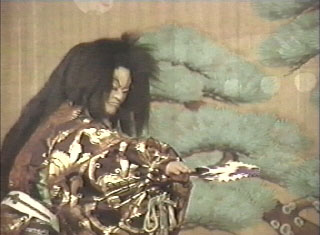
Click here for images of Susano-O battling the Orochi Dragon The great dragon arrived, saw the tempting bait laid out for  him, and began to dip each of its heads into a corresponding vat. Once it had  drunk its fill of the liquor, it became deeply intoxicated. According to most  versions of the story, the dragon fell into a deep sleep, whereupon Susano-O killed it (Nihongi 52-58). Other versions, however, including that of the sato-kagura festival from which the present image was taken, represent  Susano-O and the drunken Orochi dragon as having engaged in a fierce  hand-to-hand combat. (Click on the photo at left to see more.)

After the battle, Susano-O found (some sources say in one of the monster's  tails, others in its belly) a magnificent sword endowed with supernatural  powers,
Kusanagi-no-Tsurugi  (the "Grasscutter"). On obtaining this divine weapon, Susano-O presented it to his sister, Amaterasu, as a gesture of atonement and respect. The sword was later passed on to Amaterasu's royal grandson, Ninigi no Mikoto, the legendary founder of Japan's imperial line. The divine weapon is now enshrined at Atsuta. Some sources say, however, that the original Sword Kusanagi was lost at the famous naval battle of Dan-no-ura in 1186, when the entire fleet of the Taira clan was destroyed by the Minamoto clan. The whole royal family, with all their possessions, perished at sea (see the epic Tale of the Heike). The Minamoto clan, on the other hand, claimed that the lost sword was only a false copy anyway, and that the original was preserved.

In any case, Susano-O built for himself and his new wife a palace in the land  of Izumo. He appointed Foot-Stroking Elder to be his head steward and  immediately proceeded to beget children.

Comment: I believe that the preceding story shows that Susano-O could  sometimes have a kind and loving personality. It also shows that he had the  power of transforming. He was able to transform his bride-to-be, Princess  Kusinada, into a comb and hide her in his hair.

Susano-O is multifaceted. That is probably why I find him to be such a  fascinating character. There are many that might compare his descent to earth  with that of the biblical devil, Satan, but I do not agree. I find that the  stories that show his supposed "rough personality" really reveal him to have  very humanistic qualities. For example, when Susano-O had dealings with his  sister, he treated her as many brothers would treat their younger siblings. He  loved her so much that when he found out he was to leave heaven, he  immediately went to her to make his farewells, but as a typical brother, he  could not help but to tease her. Viewing Susano-O as a teasing, godly, older  brother, what is so odd about throwing a dead horse around, or destroying a  few crops?

It is arguable that Amaterasu's reaction of hiding in the cave represents a  petulant younger sister's irritation at her brother for picking on her. Most  scholars believe, however, that this myth was used to describe the occurrence  of solar eclipses. Amaterasu's entering of the cave would have symbolized the  blocking of the sun's light, and her emergence would represent the sun's  reappearance shortly after her return.

Overall, I find Susano-O to be a kind and giving god.

Another  tale that shows his caring nature involves repaying kindness that he received  from a very poor man. In return for his kindness, Susano-O told him how to  prevent his home from ever being plundered by the Plague God. The method was  simple: The man was to hang a plaited straw rope across the entrance of his  house. That is how the custom of preventing spreads of epidemics by hanging  straw ropes (shimenawa) along roads came to be tradition.

Further evidence illustrating Susano-O's general good nature involves one of  his sons,
O-Kuni Nushi, and O-Kuni-Nushi's half-sister, Suseri-hime. O-Kuni-Nushi wanted to marry Suseri-hime. Susano-O said he would consent to this only if O-Kuni Nushi  could show himself to be worthy. He needed to pass various ordeals in order to  prove himself. His father first put him into a room full of snakes where he was  to sleep that night. His sister, Suseri-hime had given him a magic scarf that kept him safe. He was then put through a similar ordeal with wasps and hornets. Suseri-hime gave him a scarf to protect himself in this instance also. He was  then asked by his father to retrieve a certain object from a field. When he had  gone quite a distance into the field, his father set it on fire. However, since O-Kuni-Nushi was a friend to the animals, a field mouse showed him an underground room where he could hide until the fire subsided.

After these numerous ordeals, he had finally won his father's trust. When his  father fell asleep,
O-Kuni-Nushi tied Susano-O's hair to the rafters in Susano-O's home. He then grabbed his father's sword, bow and arrows, and his  koto (a type of stringed musical instrument). O-Kuni-Nushi fled with  Suseri-hime. When Susano-O awoke, he was unable to chase them immediately  because his hair was tied to the beams of his house. After much tugging and  pulling, he tore the beams down and went after them. He was able to follow them  because of the sounds issuing from his koto. When he came within earshot of the  pair, instead of being angry, he was impressed by their cunning, and not only  allowed the marriage, but permitted them to keep the treasures they had stolen.  He also gave O-Kuni-Nushi the right to rule the province.

Comment: The ordeals that Susano-O put
O-Kuni-Nushi through in the  above story may sound harsh, but I believe that the storm god realized that  his daughter, Suseri-hime had magical scarves that could protect O-Kuni-Nushi.  Susano-O gave O-Kuni-Nushi these tests knowing that if Suseri-hime really  cared for him, she would protect him with her magic scarves. Also, Susano-O  must have been aware that his son was a friend to the animals. Therefore, he  would have known that O-Kuni-Nushi was really in no danger in the field that  he lit on fire. Basically, he gave his son tests that he knew he could not  fail. Also, he allowed his children's marriage, and did not punish them for  taking some of his prized treasures. In fact, he rewarded them! These do not  sound like the acts of a god that is mean-spirited or malicious.
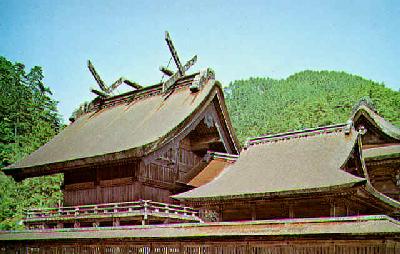
It is important for Western readers not to  misunderstand this Kami. I did not find anything in the stories I read  concerning Susano-O that showed him to be essentially bad. On the contrary, he  is recognized as a courageous deity who helps in the struggle against evil  (such as conquering the Orochi Dragon) and who graciously subordinates himself  to the supreme Kami of heaven. This is why he is worshipped together with his son, O-Kuni-Nushi, at the Izumo Shrine (see above photo; click on picture for another photo). As far as I am concerned, Susano-O is one of the most personable and fascinating of the Shinto gods. He does have a temper, and he can be impetuous, but he always means well.
Sources
  • Campbell, Joseph, The Masks of God: Oriental Mythology. New York:  Viking Penguin, 1962.
  • Guirand, Felix, Ed. New Larousse Encyclopedia of Mythology. Prometheus  Press, 1972.
  • Malm, William P.; Brown , Sidney D.; and Enrico, Eugene. Shinto Festival  Music [Videorecording]. Norman, Okla. : University of Oklahoma, Center for  Music Televison, c1993.
  • Nihongi (Chronicles of Japan from the Earliest Times to A.D. 697). Translated by W.G. Aston. London: George Allen & Unwin, 1956.
  • Tsunoda, Ryusaku; de Bary, William Theodore; and Keene, Donald, Eds. Sources of Japanese Tradition. New York: Columbia University Press, 1958.
Sursa: http://www.onmarkproductions.com/html/susano-o-no-mikoto.html

Japonia - scurta prezentare turistica

Japonia sau Tara Soarelui Rasare, in japoneza Nipponkoku e o tara situata in Asia de Est, numele acesteia insemnand Originea Soarelui. Este situata pe un lant de insule aflate intre Oceanul Pacific si Marea Japoniei, la est de Peninsula Coreana.
Potrivit unei legende, Japonia a fost creata de catre zei. Acestia au infipt o sabie in ocean iar la scoaterea ei s-au format patru picaturi ce au devenit insulele principale iar in jurul lor o multime de insule mici, peste 5000 la numar.
Cele patru insule importante ce incorporeaza aproape in totalitate teritoriul Japoniei sunt:Honsu, Hokkaido, Kyushu si Shikoku.

Japonia este o imbinare intre Occident si Orient, fiind un impresionant producator de masini, computere si in acelasi timp tinutul geishelor, a bonsailor sau a ceremonialului ceaiului iar orasele sale au adoptat multe elemente vestice si in acelasi timp si-au pastrat putin din misterul civilizatiei stravechi japoneze.
Aula Marelui Buddha, se afla in Templul Todaiji si reprezinta o statuie gigantica ce il reprezinta pe Buddha ce binecuvanteaza cu mana sa ridicata toti credincioasii ce vin sa il vada si masoara 58 de m lungime si 51 de m latime. Alte atractii ale templului sunt: Pagodele cu cele doua Aule din sec VIII, cartierele generale ale preotilor, un mic muzeu al breslelor chineze si coreene si doua statui din nisele portii de cate 8 m fiecare, cunoscute sub numele de Regii Deva.

Un alt punct de maxima importanta pentru Japonia il reprezinta Portalul Lacului Itsukushima, care vegheaza una din cele mai respectate sanctuare ale tarii. Torii e cel mai renumit portal al Japoniei, construit din lemn rosu si apartine sanctuarului Itsukushima de pe insula Miyajima. Acesta se ridica din apele unui golf iar dincolo de aceasta se afla constructiile sanctuarului, cu ziduri albe si busteni rosii si muntii insului.
Sanctuarul e unul din cele mai venerate locuri din Japonia, iar sacralitatea insulei e ridicata la un grad atat de mare incat nimanui nu i s-a permis sa se nasca sau sa moara aici.
Capitala si cel mai mare oras al tarii este Tokyo, o stralucita metreopola.

Tokyo este cel mai important centru comercial si cultural al tarii, avand peste 400 de institutii de invatamant superior, peste 50 de biblioteci , academia japoneza, 600 de cinematografe si in jur de 2000 de temple. Cea mai impunatoare cladire a orasului este Turnul Televiziunii, cu o inaltime de 334 m, ce ofera o superba panorama asupra orasului. Ce nu trebuie ratat in Tokyo:
Asakusa – cel mai mare district al orasului, situat pe malul raului Sumida. Este renumit pentru numeroasele magazine, cinematografe, viata si cluburi de noapte, precum si centre de recreere.  Centrul istoric al districtului este Templul Sensoij, cel mai vechi templu budist; in Japonia 83% din populatie, sunt de religie budistia. Acest templu a fost construit pentru zeita Kannon, cele mai respectate si iubite zeite, simbol al bunatatii si milei pentru toti cei care sufera. Ansamblul este format din 10 cladiri pe un teritoriu destul de mare, cu trei porti principale fiecare avand propriul simbol. De la poarta principala Kaminarimon (Poarta Tunetului), strada Nakamise duce catre sala templului Sensoij si reprezinta  o mare atractie turistica pentru cei care ajung aici – o varietate de magazine, restaurante si multe suveniruri traditionale japoneze. Anual in Asakusa, in iulie are loc Festivalul Florilor, iar in decembrie au loc targurile de arta.
Ginza – un district si o strada cu acelas nume, un paradis pentru consumatorii magazinelor de lux, celor mai renumite brand-uri, cele mai deosebite restaurante si cele mai moderne cluburi de noapte. Aici veti gasi cele mai scumpe magazine din lume, cu vitrine artistic decorate folosindu-se cele mai recente tehnologii. Ginza este considerat un muzeul progresului economic din Japonia. Sambata si duminica, precum si in timpul festivalurilor, strada este inchisa traficului devenind o mare zona pietonala.
Palatul Imperial – dinastia imperiala Japoneza este cea mai veche dinanstie cunoscuta; potrivit cronicilor primul imparat a urcat pe tron in 660 IHR.  Palatul Imperial, un simbol al culturii japoneze, este situat in inima orasului, fiind inconjurat de un parc cu stanci inalte, protejand intreaga zona de restul Megalopolisului. Daca doriti sa vizitati Palatul, acesta este deschis doar de 2 ori pe an: pe 2 ianuarie (cu ocazia noului an) si pe 23 decembrie (ziua de nastere a imparatului). Palatul dateaza efectiv de la sfarsitul secolului 16, dar ca o mare parte a orasului si acesta a fost practic distrus in timpul celui de-al doilea razboi mondial, iar reconstruirea lui a fost completa abia in 1968. Trebuie mentionat ca Palatul difera foarte mult de palatele regale europene, prin simplitatate si lipsa luxului. Puncte de atractie turistica sunt gradinile deschise publicului din jurul Palatului, si parcul Kitamonaru considerat cel mai fumos loc pentru a te bucura de minunea oferita la inceputul verii de arborii cu flori de cirese, simbol al Japoniei.
Odaiba – este orasul viitorului. Cladirea Fuji Tv este una dintre cele mai representative cladiri din zona, la etajul 25 aflanduse un glob gigantic de observare, din sticla de unde sedeschide o panorama unica de unde poti vedea Tokyo ca din nicio alta parte. Venus Fort – “un oras in oras” special creat pentru femei. De afara nu are deloc atractivitate, pare mai degraba un hangar pentru avioane militare, in interior insa vei descoperi un centru modern de cumparaturi, exclusiv decorat in stil italian: fantani arteziene, strazi pavate, galerii arcuite, totul pentru a te relaxa si a te imagina pentru cateva ore intr-un vechi oras italian al secolului al 18-lea.  In Aqua-City gasiti cele mai mari shopping mall-uri din Japonia, peste 150 de cafenele si restaurante, cinematografe utra-moderne, un loc care nu trebuie ratat ce poate adaposti 3000 de vizitatori simultan. Sega Joypolis – este  paradisul jocurilor virtuale, doar sunteti in Japonia.
Parcul National Shinjuku Gyoen – in Japonia, frumusetea naturii este un lucru sacru si apreciata ca in nicio alta parte a lumii. Tokyo dispune de un numar impresionant de parcuri naturale, peste 7000, cel mai mare dintre ele fiind Shinjuku Gyoen ce ocupa 58,3 ha si are aproximativ 20 de mii de arbori, 1500 dintre ei fiind ciresi. De la mijlocul lunii februarie pana in aprilie, ofera o imagine ineditata, iar in perioada arborilor infloriti este cea mai vizitata zona din Japonia. In luna noembrie turistii vin sa admire crizantemele inflorite, cultivate prin tehnici traditionale.
Turnul Tokyo – dupa razboi guvernul a cautat un monument ce sa simbolizeze renasterea Japoniei ca o super putere mondiala, astfel au decis construirea propriului Turn Eiffel, in inima capitalei. Constructia acestuia a fost finalizata in 1958 si a intrat in cartea recordurilor ca cel mai inalt turn din otel.
Akihabara sau Orasul Electic, ezte zona ideala pentru cumparaturi, aici gasindu-se cele mai avansate produse elecrtice. Vulcanul sfant japonez, Fuji-Yama e format dintr-un con vulcanic cu o inaltime care ajunge la 3376m, reprezentand cel mai inalt punct al acestei tari.
Yokohama, este cel mai mare si important port al tarii, reprezentand poarta maritima a capitalei. Cunoscut si sub numele de Venetia Japoniei sau Manchesterul Orientului, Osaka, e un oras port situat in sudul insulei Honshu, in golful Osaka. Acesta e cunoscut mai degraba pentru arhitectura moderna, industria, zgarie-norii si zonele sale vaste de cumparaturi decat pentru istoria sa.
Acesta are doua centre principale: Kita, centrul de afaceri si Minima cunoscut pentru magazinele, restaurantele sale si pentru divertisment. Castelul Osaka, e una din principalele atractii ale orasului, fiind mai degraba un muzeu in forma in castel, unde localnicii se aduna la sfarsit de saptamana pentru picnic.
Unul din cele mai vechi altare Shinto din Japonia este Altarul Sumiyoshi Tanish, ce dateaza de 1800 de ani, arhitectura sa traditionala fiind neosbinuita pentru altarele japoneze.
Alte atractii turistice ale oarsului sunt: Muzeul in aer liber Vechile Ferme, Acvariul Kaiyukan, Teatrul National Bunraku si Sky Building.

     Osaka este un oraş din Japonia, centrul administrativ al prefecturii Osaka. Este situat la gura râului Yodo (sau Yodogawa), pe malul golfului Osaka, în regiunea Kansai a insulei Honshu. Cu o populaţie de 2.636.257 locuitori (ian. 2007) şi o suprafaţă de 222 km², Osaka este al doilea mare oraş din Japonia, după Tokyo. Este inima zonei metropolitane Osaka-Kobe-Kyoto, care are o populaţie de 18.644.000 locuitori. Osaka, oras-port cunoscut si sub numele de “Venezia Japoniei” sau “Manchester-ul Orientului” , este situat în sudul insulei Honshu, în golful Osaka, pe malul râului Yodo, este capitala districtului Osaka. este o metropolă industrială specializată în industria textila (bumbac), industria feroasă, ind. constructiilor de masini, echipament electronic si ciment. Aici sunt cele mai renumite târguri internationale pentru produsele industriei usoare asiatice.  Osaka este un oras dezvoltat si din punct de vedere al turismului pe latura culturală, în special, astfel, cele mai inportante puncte turistice sunt templele: Tammangu-secolul x, Shitennoji-secolul 6 si Temmangu, oras cu izvoare termale, în apropiere de Osaka.
Hiroshima e situata in sud-vestul insulei Honshu, fiind capitala districtului cu acelasi nume. In fiecare an in 6 august, sute de mii de oameni participa la manifestari in Parcul Memorial al Pacii, construit in locul unde a explodat bomba. Japonezii au numit Hiroshima ca fiind Altarul international al pacii.
      Kyoto are un dialect aparte (Kyo Kotoba), cu o istorie lungă, reflectată în rafinata cultură a acestui oraş, capitală a Japoniei pentru mai mult de o mie de ani (794-1868). Astfel, sunetul unor cuvinte folosite de locuitorii Kyoto-ului de azi au o muzicalitate aparte faţă de japoneza standard, fapt datorat atât poziţiei geografice a oraşului, noilor influenţe din lumea contemporană, cât şi relaţiei dintre oameni şi limba japoneză. Unele expresii folosite în dialectul din Kyoto nu pot fi intelese doar prin simpla citire a caracterelor, fie ele kanji sau kana. Kyoto, oras situat in sudul insulei Honshu, capitala regiunii urbane Kyoto, lângă Osaka, este faimos pentru mestesugurile cu fire de mătase, bronz, portelan, chimicale, echipament electronic. Kyoto este cunoscut si pentru splendidele festivale anuale si pentru superbele grădini. Tot în această zonă se află si castelul Nijo, palatul imperial Kyoto, morminte foarte vechi, universitatea Kyoto (1897) si numeroase muzee. Kyoto servea ca o capitată imperială a Japoniei, aproape continuu, între 794-1868, când sediul administrativ a fost mutat la Tokio. O importată culturală ar fi ruinele din urma bombardamentelor din cel de-II-lea război mondial.
     Chiba, capitala regiunii Chiba, este amplasată în sud-estul insulei Honshu si totodată în extremitatea de nord-est a golfului Tokyo. Chiba este un important nod feroviar care leagă Tokyo de peninsula Boso. Coasta de nord a golfului Tokyo dintre Urayasu si Kisarazu s-a transformat într-o zonă industrială în ceea ce priveste petrochimia, constructiile navale, ind. siderurgică numită Keiyo (Tokyo-Chiba). Templul Chiba este cel mai vechi obiectiv turistic al orasului fondat în 709.
     Fukuoka, este capitală a regiunii cu acelasi nume, situată în nord-vestul insulei Kiushu din golful Hakata. orasul, împărtit de râul Naka, include Fukuoka, pe latura vestică, un oras-cetate al familiilor de baroni feudali datând din 1601 si Hakata, pe latura estică, un spatiu comercial a cărei importantă în sec. al-XVII-lea, era poarta Japoneză spre China. Orasul este cel mai apropiat mare port al Japoniei de continentul Asiatic. De-a lungul golfului Hakata se află rămăsitele zidului de apărare de 3 metri, construit în secolul al-XVIII-lea pentru a proteja orasul de invaziile armatelor mongole. Tot în oras, ca obictive turistice pot fi enumerate: Universitatea Kiushu (1911) si Universitatea Fukuoka, datând din anul 1934.

(sursa: http://turismblog.ro/japonia/.html)